
Herringbone and Pattern Tiling in Croydon, Set Out Before the First Cut
A pattern is decided before the first tile goes down. The centre line, the starting point and where the cuts land at the edges are what separate a good herringbone from a bad one.
10/10 on Checkatrade · Checkatrade vetted
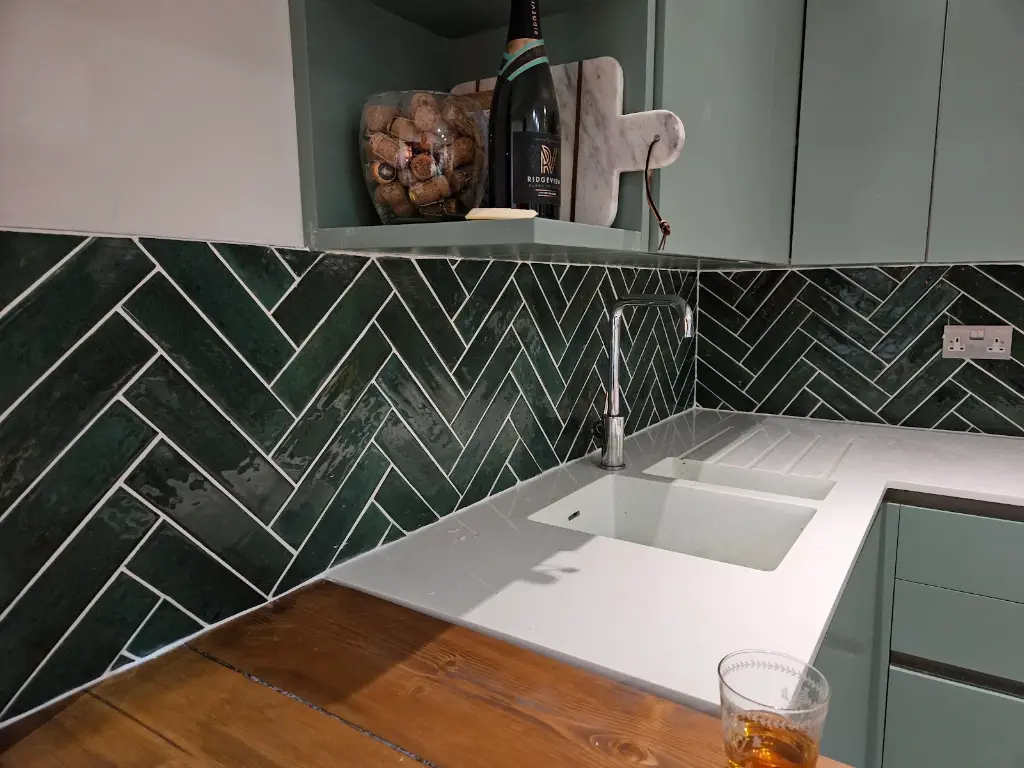
Herringbone is the best-known laid pattern, but it is not the only one. Chevron, basketweave, brick bond at an angle and other set patterns all share the same starting point: someone has to decide the centre line, the first tile and the direction of the pattern before any tile is fixed, because that decision is what the rest of the floor or wall follows.
We have fitted a herringbone splashback in dark green gloss around a kitchen sink and tap run. The demanding part of that job was not the field of the pattern, it was the joint lines where the cuts met the tap and the shelved recess. That is true of most pattern work: the repeat looks after itself, the edges do not.
The common patterns and where each suits a room
Standard herringbone runs at 90 degrees, with each tile's short end butting the long side of the next, and works well along a hallway or through an open floor where the length of the run lets the zigzag read properly. Chevron looks similar at a glance but uses tiles cut at an angle so the pattern forms a continuous V rather than a stepped zigzag, which needs a tile made for that specific angle rather than a rectangular plank simply laid on the diagonal.
A kitchen splashback is a smaller, more contained space than a floor, so the pattern reads differently. A herringbone splashback usually centres on a focal point such as the hob, tap or a window, with the pattern built out symmetrically from there rather than starting at one end of the wall and running to whatever's left at the other.
Setting out decides the result before the first tile is fixed
The centre line and starting point are marked out on the floor or wall before anything is stuck down. Get that wrong and the problem does not show up straight away: it shows up as the pattern drifting out of true by the time it reaches the far wall, or as a run of narrow slivers along one edge where a wider, more even cut would have looked better.
Doorways, thresholds and the room's main sight line all affect where that starting point should sit. A pattern that is centred on the room but ignores the doorway can leave an awkward cut exactly where people walk in, so setting out has to balance the geometry of the pattern against the practical realities of the room, not just centre it on the longest wall.
The extra material, cutting and time a pattern costs against a straight lay
A pattern uses more tile than a straight lay of the same area. Every tile that meets a wall, corner or edge in a herringbone or chevron run is cut at an angle rather than square, and an angled cut wastes more of the tile than a square one does, so the wastage allowance is higher and more boxes need to be ordered.
Setting out and cutting also take longer than a straight or grid lay of the same size, because we check the centre line again and again as the pattern spreads out from it, and every edge tile is measured and cut on its own rather than following one repeated cut.
A clear route from enquiry to finish
- 01
Choose the pattern
Agree herringbone, chevron or another set pattern for the floor or splashback.
- 02
Mark the centre line
Set out the starting point and reference lines before any tile is fixed.
- 03
Dry lay a section
Check the pattern and cut positions against doorways, focal points and edges.
- 04
Fix and finish
Lay, cut, grout and finish the pattern from the agreed centre line outward.
Herringbone & Pattern Tiling cost in Croydon
A reliable quote needs the room, tile and preparation scope. These are the main factors to share.
- Higher cut count
- Wastage allowance
- Setting out time
- Tile size
- Pattern chosen (herringbone, chevron or other)
See the wider planning, related repairs and other options on the parent service page.
Explore Floor TilingCroydon, South London and surrounding areas
Coverage depends on the project and schedule. Send the postcode with the room and tile details.
Four things agreed job by job
These are not assumed either way. They get priced and agreed with you before the work starts, so nothing turns into a surprise on the invoice.
- Removing old tiles
- Waste disposal and any skip
- Substrate preparation, levelling and boarding
- Clearing the space before we arrive
Questions people ask before booking
Every project is different. These answers set expectations before the room and tiles are assessed.
How much extra tile does a herringbone pattern need compared with a straight lay?
Angled cuts waste more of a tile than a square cut, so a herringbone or chevron pattern typically needs a noticeably higher wastage allowance than a straight or grid lay of the same area. The exact percentage depends on the tile size and the room's shape, since more corners and edges create more cut tiles than a simple rectangle.
Does herringbone suit a small room?
It can, but a small pattern repeat on a small tile tends to work better in a compact room than a large-format plank laid in herringbone, which can feel busy in a limited space. The starting point also matters more in a small room, since there is less length for the pattern to settle into before it reaches the far wall.
Can herringbone be used on a kitchen splashback as well as a floor?
Yes, and it is a common request. A splashback is a smaller, more contained area than a floor, so the pattern is usually set out from a focal point such as the hob or tap rather than run continuously from one end of the wall to the other.
Do you lay chevron as well as herringbone?
Where the tile is manufactured with the correct angled edge for it. Chevron needs a tile cut for that specific pattern rather than a standard rectangular tile laid on the diagonal, so the format available affects which pattern is realistic.
Planning herringbone & pattern tiling in Croydon?
Send a few photos, rough measurements and the tile you are looking at. Quotes are free, and most jobs can be priced from that without anyone coming out.